Application Ecosystem
SafeSquid SWG is a modular, cloud-integrated platform that unifies policy decisions, combines intelligent threat detection with deep content inspection, and supports seamless multi-cloud deployment.
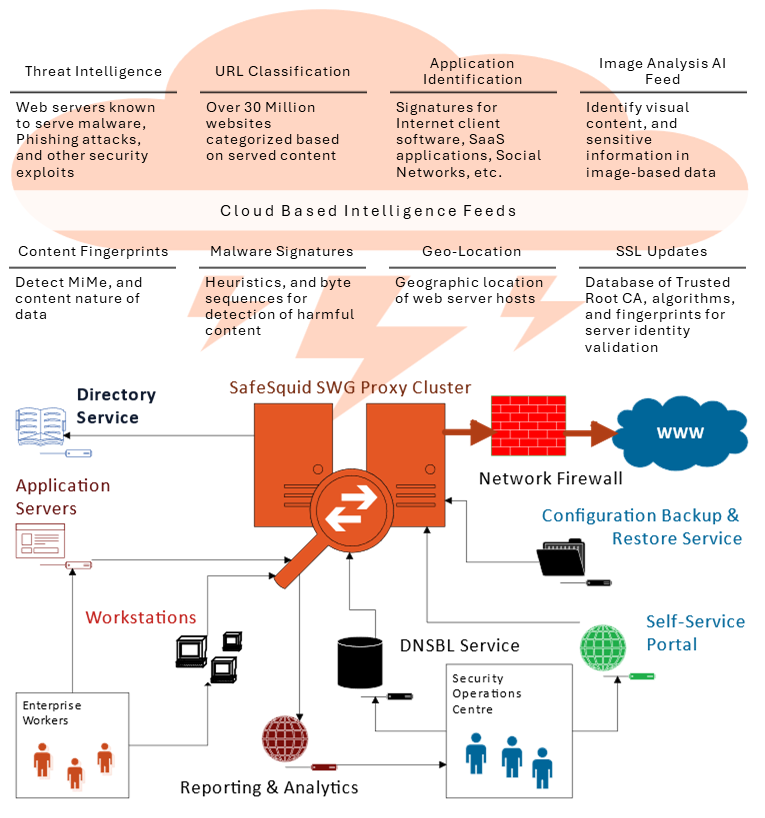
Why a Unified Ecosystem?
The Problem: Enterprises stitching together multiple security appliances inherit:
- Policy drift across tools
- Inspection blind spots
- High operational overhead
- Inconsistent enforcement
SafeSquid's Solution: A single, modular system that:
- Scales horizontally: Clustered proxies grow without policy drift
- Centralizes L7 control: Unified policy engine delivers consistent outcomes
- Provides audit-ready operations: Built-in reporting/forensics and versioned backups
- Secures by design: Selective TLS interception, true-MIME validation, and policy-aware DNS
Architectural Planes
SafeSquid splits responsibilities into planes so each solves a distinct problem without collisions, simplifying scale, upgrades, and audit.
Data Plane
Challenge: Modern HTTPS hides intent, but blind pass-through misses attacks while heavy inspection adds latency.
Solution: The SafeSquid Proxy Cluster sits in the path and:
- Validates TLS
- Decrypts selectively under policy
- Inspects HTTP semantics
- Scans content exchanged
- Enforces security policies
Nodes remain stateless and scale horizontally behind load balancers.
Control Plane
Challenge: Dozens of proxies with slightly different rules risk "all-or-nothing" pushes that break traffic.
Solution: The Policy Configuration Console becomes the source of truth:
- Teams author, simulate, review, and approve changes
- Staged rollouts with RBAC
- Versioning and diffs make changes auditable and reversible
- Updates move quickly without surprises
Management Plane
Challenge: Licenses, activation keys, and certificate lifecycles scatter across tools, slowing operators and creating outages.
Solution: The Self-Service Portal centralizes routine jobs:
- Activate or renew licenses
- Manage enterprise root CA and OCSP/CRL settings
- Enroll connectors
- Adjust organization settings
- Role-scoped access and activity history
Observability Plane
Challenge: Incident response and compliance fail when logs lack context or arrive late.
Solution: Reporting & Forensics streams structured telemetry (JSON/CEF/syslog) with evidence fields:
- Dashboards show health and policy outcomes in real time
- Scheduled CSV/PDF reports satisfy audit cycles
- No manual exports needed
Core Components
-
SafeSquid Proxy Cluster
Central enforcement point for all HTTP/HTTPS traffic, performing full proxying, in-line inspection, and policy enforcement. -
Policy Management Console
Administrative interface for defining, simulating, and enforcing access control, URL filtering, SSL inspection, DLP, and other security policies. -
Self-Service Portal
Web portal for managing cloud-integrated features: activation keys, license management, Root CA certificates. -
Reporting & Forensics
Real-time dashboards, customizable reports, and forensic logging for visibility, compliance, and incident investigation. -
Integrated DNS Security
Hardened internal DNS resolver with policy-aware resolution, blocking of malicious domains, and mitigation of DNS tunneling and spoofing attacks. -
Cloud-Based Configuration Backup & Restore
Cloud-synchronized backup system with version-controlled policy snapshots for seamless restoration and rollback. -
Cloud-Based Threat Intelligence Feeds
Real-time intelligence feeds injected directly into the enforcement pipeline for maximum relevance.
Supporting Services
For production use, deploy SafeSquid with supporting services for high availability, monitoring, and performance:
-
Monit
Monitoring service that ensures zero downtime: auto-restarts processes, cleans temporary files, fetches threat intelligence updates. -
BIND
Local DNS resolver that accelerates lookups by caching and using root DNS servers directly. -
NTP
Time synchronization critical for Active Directory SSO and TLS certificate validation.
Integrations
Enterprise-Ready Integrations: SafeSquid easily integrates with:
- IAM systems (Active Directory, LDAP, SAML)
- ICAP servers (external content scanning)
- DLP systems (data loss prevention)
- SIEMs (Splunk, ELK, QRadar)
- SoC threat intelligence platforms
These integrations allow SafeSquid to blend seamlessly into your existing environment.
Directory Structure
SafeSquid's directory structure adheres to the Linux Filesystem Hierarchy Standard and logically organizes:
- Service initialization scripts
- Log management (
/var/log/safesquid/) - Module loading
- UI rendering
- System performance tuning
- SSL certificates (
/usr/local/safesquid/security/) - Content filtering modules
- DLP configuration
- Caching (
/var/db/safesquid/) - Analytics
This structure ensures easy maintenance, debugging, and extensibility.
Next Steps
- Configuration Portal — Access the admin interface and configure policies
- Supporting Services — Set up Monit, BIND, and NTP for production readiness
- SSL Inspection — Enable HTTPS decryption
- Authentication — Integrate with Active Directory or LDAP