> ## Documentation Index
> Fetch the complete documentation index at: https://docs.safesquid.com/llms.txt
> Use this file to discover all available pages before exploring further.
# Redirect
 ## Overview
The `Redirect` section allows SafeSquid to intercept requests for specific URLs and either internally rewrite them (fetching content from a new destination on behalf of the client) or send an HTTP 302 redirect back to the client’s browser.
## Core Mechanics (C++ Source Validation)
First-match URL/Location rewrite, send302 branching.
* **Evaluation Order**: Rules are evaluated top to bottom. The first matching rule takes effect and evaluation stops for that pass.
* **PCRE Matching**: The `URL` field accepts Perl Compatible Regular Expressions (PCRE) with capture groups (e.g., `(.*)`), which can be referenced in the `Redirect` field using `$1`, `$2`, etc.
* **Internal Rewrite vs. 302**: If `send302` is false, SafeSquid fetches the rewritten URL and serves the content transparently. If true, it returns an HTTP 302 Location redirect to the client.
## Schema Fields
### Global Fields
* **Enabled (enabled)**: Toggles URL redirection globally.
### Rule-Based Fields (Per Connection Tuning)
* **Enabled (enabled)**: Toggles the rule.
* **Comment (comment)**: User description. Logged on match when non-empty.
* **Profiles (profiles)**: The trigger condition. Limit this entry to connections that already carry these Access Profile tags.
* **URL (url)**: PCRE matched against the request URL or Location header.
* **Redirect (redirect)**: The replacement template after the PCRE match.
* **Port (port)**: When > 0, forces this destination port on internal rewrite. `0` keeps the port from the rewritten URL.
* **302 redirect (send302)**: Set to `Yes` for HTTP 302, or `No` for internal transparent fetch.
* **Options (options)**: Bitmask/list of options: Decode URL before match (`DECODEBEFORE`), encode URL path (`ENCODE`), or decode URL path after substitution (`DECODEAFTER`).
* **Applies to (which)**: Match client request URL (`URL`), response Location header (`LOCATION`), or both (`BOTH`).
## How SafeSquid processes the list
1. On the client request, SafeSquid builds `proto://host/file` and tests rows whose Applies to includes URL (or BOTH).
2. On redirect responses, SafeSquid tests the response `Location` value for rows that include LOCATION (or BOTH).
3. First enabled row that matches profiles, URL regex, and direction wins; processing stops.
4. **302 redirect = No** (default): rewrite `proto`, `host`, `file`, and optional port on the request and fetch internally; request type may become HTTP proxy.
5. **302 redirect = Yes**: send HTTP 302 to the client with the rewritten URL as Location; no origin fetch for that request.
6. Options: percent-decode before PCRE match; URL-encode or decode the path portion after substitution.
**Order matters.** Put specific URL patterns above broad catch-alls — first match wins.
## Important entry fields
* **Profiles** — Apply only when the connection has one of these profiles. Blank = all connections. Prefix `!` to skip connections that have a profile.
* **URL** — PCRE with capture groups matched against the request URL or Location header. Required; blank URL skips the row.
* **Redirect** — Replacement template after PCRE match (supports `$1` captures and connection variables).
* **Port** — When > 0, force this destination port on internal rewrite. 0 keeps the port from the rewritten URL.
* **302 redirect** — **Yes** — HTTP 302 to client. **No** — internal rewrite and fetch.
* **Applies to** — URL (request only), LOCATION HEADER (response redirects only), or BOTH (separate processing passes).
## Examples
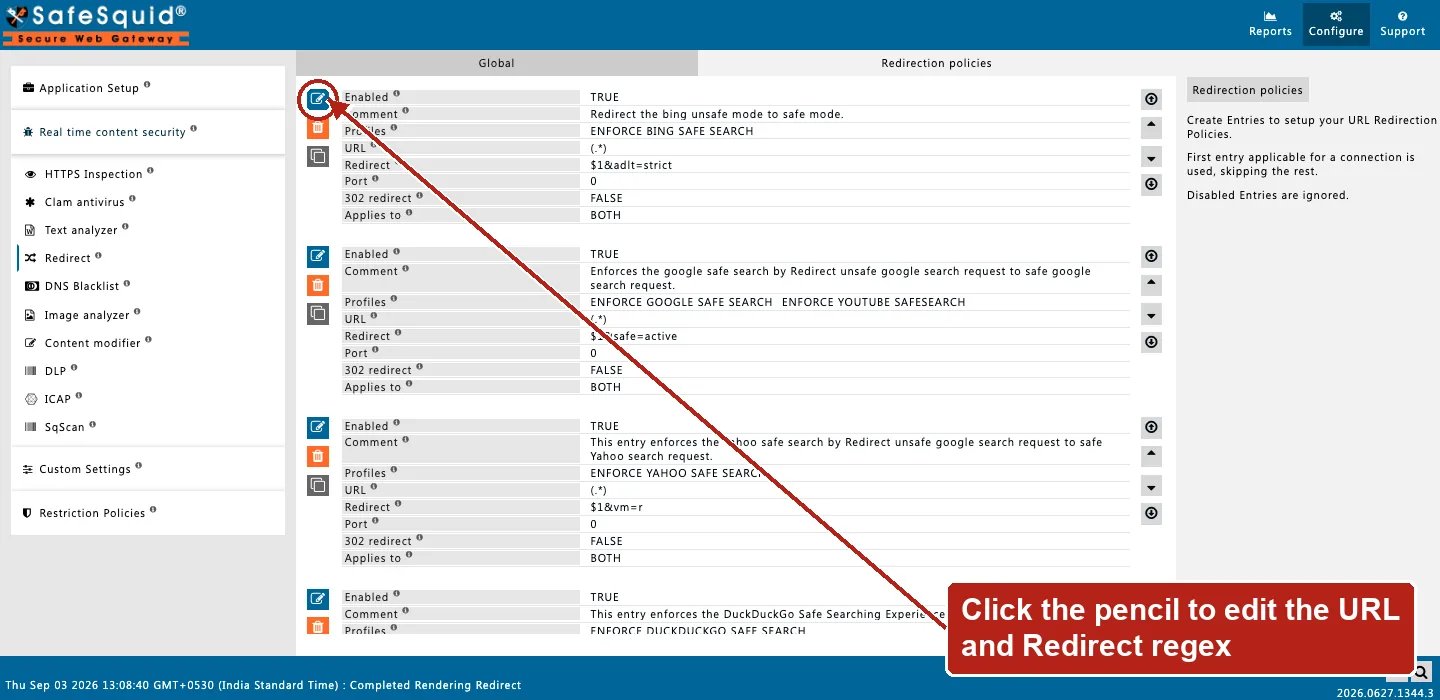
Open **Configure → Real time content security → Redirect → Redirection policies**. Row fields are
Enabled, Comment, Profiles, URL, Redirect, Port, 302 redirect, and Applies to — the shipped
default rows enforce safe search on Bing, Google, Yahoo, and DuckDuckGo.
## Overview
The `Redirect` section allows SafeSquid to intercept requests for specific URLs and either internally rewrite them (fetching content from a new destination on behalf of the client) or send an HTTP 302 redirect back to the client’s browser.
## Core Mechanics (C++ Source Validation)
First-match URL/Location rewrite, send302 branching.
* **Evaluation Order**: Rules are evaluated top to bottom. The first matching rule takes effect and evaluation stops for that pass.
* **PCRE Matching**: The `URL` field accepts Perl Compatible Regular Expressions (PCRE) with capture groups (e.g., `(.*)`), which can be referenced in the `Redirect` field using `$1`, `$2`, etc.
* **Internal Rewrite vs. 302**: If `send302` is false, SafeSquid fetches the rewritten URL and serves the content transparently. If true, it returns an HTTP 302 Location redirect to the client.
## Schema Fields
### Global Fields
* **Enabled (enabled)**: Toggles URL redirection globally.
### Rule-Based Fields (Per Connection Tuning)
* **Enabled (enabled)**: Toggles the rule.
* **Comment (comment)**: User description. Logged on match when non-empty.
* **Profiles (profiles)**: The trigger condition. Limit this entry to connections that already carry these Access Profile tags.
* **URL (url)**: PCRE matched against the request URL or Location header.
* **Redirect (redirect)**: The replacement template after the PCRE match.
* **Port (port)**: When > 0, forces this destination port on internal rewrite. `0` keeps the port from the rewritten URL.
* **302 redirect (send302)**: Set to `Yes` for HTTP 302, or `No` for internal transparent fetch.
* **Options (options)**: Bitmask/list of options: Decode URL before match (`DECODEBEFORE`), encode URL path (`ENCODE`), or decode URL path after substitution (`DECODEAFTER`).
* **Applies to (which)**: Match client request URL (`URL`), response Location header (`LOCATION`), or both (`BOTH`).
## How SafeSquid processes the list
1. On the client request, SafeSquid builds `proto://host/file` and tests rows whose Applies to includes URL (or BOTH).
2. On redirect responses, SafeSquid tests the response `Location` value for rows that include LOCATION (or BOTH).
3. First enabled row that matches profiles, URL regex, and direction wins; processing stops.
4. **302 redirect = No** (default): rewrite `proto`, `host`, `file`, and optional port on the request and fetch internally; request type may become HTTP proxy.
5. **302 redirect = Yes**: send HTTP 302 to the client with the rewritten URL as Location; no origin fetch for that request.
6. Options: percent-decode before PCRE match; URL-encode or decode the path portion after substitution.
**Order matters.** Put specific URL patterns above broad catch-alls — first match wins.
## Important entry fields
* **Profiles** — Apply only when the connection has one of these profiles. Blank = all connections. Prefix `!` to skip connections that have a profile.
* **URL** — PCRE with capture groups matched against the request URL or Location header. Required; blank URL skips the row.
* **Redirect** — Replacement template after PCRE match (supports `$1` captures and connection variables).
* **Port** — When > 0, force this destination port on internal rewrite. 0 keeps the port from the rewritten URL.
* **302 redirect** — **Yes** — HTTP 302 to client. **No** — internal rewrite and fetch.
* **Applies to** — URL (request only), LOCATION HEADER (response redirects only), or BOTH (separate processing passes).
## Examples
Open **Configure → Real time content security → Redirect → Redirection policies**. Row fields are
Enabled, Comment, Profiles, URL, Redirect, Port, 302 redirect, and Applies to — the shipped
default rows enforce safe search on Bing, Google, Yahoo, and DuckDuckGo.
 ### 1 — Force Google safe search (internal rewrite)
* URL: `^https://(www\.)?google\.com/search\?(.*)`
* Redirect: `https://www.google.com/search?safe=active&$2`
* 302 redirect: **No**, Applies to: URL
**Result:** matching Google search requests are rewritten and fetched by SafeSquid with `safe=active`; the browser address bar stays on the original URL pattern.
### 2 — Send users to a block info page (302)
* URL: `^https://old-portal\.example\.com/`
* Redirect: `https://intranet.example.com/moved.html`
* 302 redirect: **Yes**
**Result:** client receives HTTP 302 with Location set to the new URL; SafeSquid does not fetch the old portal for that request.
### 3 — Rewrite outbound redirect Location
* Applies to: LOCATION HEADER
* URL: `^http://cdn\.example\.com/(.*)`
* Redirect: `https://cdn.example.com/$1`
**Result:** when the origin returns a redirect whose Location matches, SafeSquid replaces Location with the HTTPS form before the response reaches the browser.
### 4 — Profile-gated redirect only for guests
* Profiles: `Guest`
* URL: `^https://mail\.example\.com/`
* Redirect: `https://webmail-lite.example.com/`, 302 redirect: **Yes**
**Result:** Guest users get 302 to webmail-lite; staff without the Guest profile skip the row and reach mail.example.com normally.
## How to verify
1. Reproduce the URL from a client and watch whether the browser receives 302 or content from the rewritten host.
2. Enable REDIRECT in `LOG_LEVEL` for native lines showing match, internal rewrite, or an HTTP 302.
3. Open **Reports → Detailed logs** for the requested URL and response code.
4. Pair Redirect profile tags with rows in Access Profiles (tags are not hard-coded — both sections must reference the same tag string).
## Related topics
- [Redirect One Website to Another](/use_cases/url_redirection/redirect_one_website_to_another.md)
- [URL Redirection](/use_cases/url_redirection/url_redirection.md)
- [Transparent Proxy](/use_cases/scaling_and_high_availability/transparent_proxy.md)
- [WCCP](/use_cases/scaling_and_high_availability/wccp.md)
- [Security Logs](/use_cases/audit_and_forensics/security_logs.md)
### 1 — Force Google safe search (internal rewrite)
* URL: `^https://(www\.)?google\.com/search\?(.*)`
* Redirect: `https://www.google.com/search?safe=active&$2`
* 302 redirect: **No**, Applies to: URL
**Result:** matching Google search requests are rewritten and fetched by SafeSquid with `safe=active`; the browser address bar stays on the original URL pattern.
### 2 — Send users to a block info page (302)
* URL: `^https://old-portal\.example\.com/`
* Redirect: `https://intranet.example.com/moved.html`
* 302 redirect: **Yes**
**Result:** client receives HTTP 302 with Location set to the new URL; SafeSquid does not fetch the old portal for that request.
### 3 — Rewrite outbound redirect Location
* Applies to: LOCATION HEADER
* URL: `^http://cdn\.example\.com/(.*)`
* Redirect: `https://cdn.example.com/$1`
**Result:** when the origin returns a redirect whose Location matches, SafeSquid replaces Location with the HTTPS form before the response reaches the browser.
### 4 — Profile-gated redirect only for guests
* Profiles: `Guest`
* URL: `^https://mail\.example\.com/`
* Redirect: `https://webmail-lite.example.com/`, 302 redirect: **Yes**
**Result:** Guest users get 302 to webmail-lite; staff without the Guest profile skip the row and reach mail.example.com normally.
## How to verify
1. Reproduce the URL from a client and watch whether the browser receives 302 or content from the rewritten host.
2. Enable REDIRECT in `LOG_LEVEL` for native lines showing match, internal rewrite, or an HTTP 302.
3. Open **Reports → Detailed logs** for the requested URL and response code.
4. Pair Redirect profile tags with rows in Access Profiles (tags are not hard-coded — both sections must reference the same tag string).
## Related topics
- [Redirect One Website to Another](/use_cases/url_redirection/redirect_one_website_to_another.md)
- [URL Redirection](/use_cases/url_redirection/url_redirection.md)
- [Transparent Proxy](/use_cases/scaling_and_high_availability/transparent_proxy.md)
- [WCCP](/use_cases/scaling_and_high_availability/wccp.md)
- [Security Logs](/use_cases/audit_and_forensics/security_logs.md)